
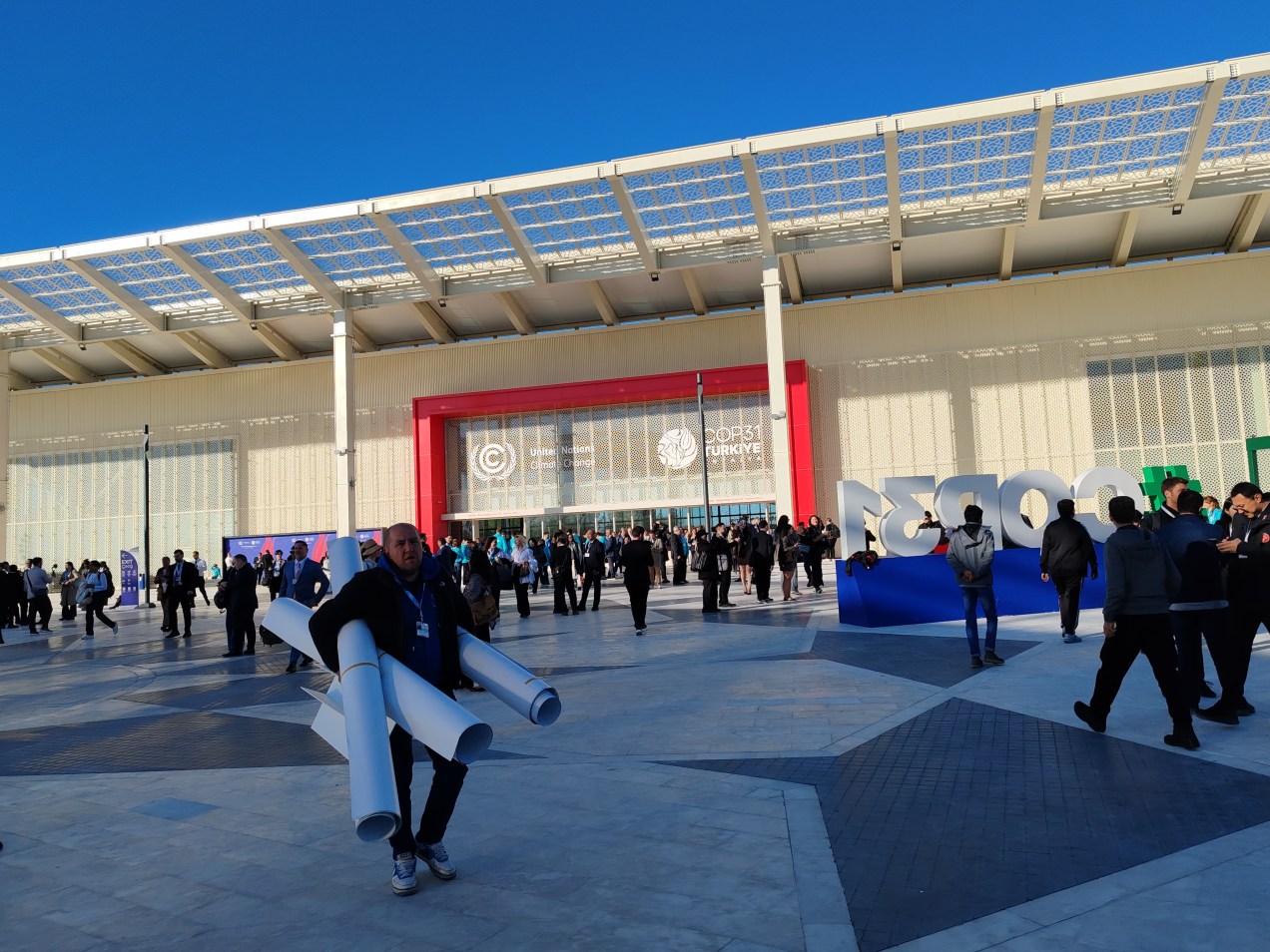
What happened at Cop31 is not the EU winning the flag of climate champion, but, instead, the fact that half of the world refuses the Western pace of a necessary, and unavoidable, energy transition. Let’s see why.
Antalya started at a slow pace. No big announcements on the first day like in the previous years: no headlines. The goal for the co-shared presidency (Turkey and Australia, with the latter leading the negotiations) was to reach the so-called “35×35”, i.e. adopting a text to bring the share of the world’s final energy consumption accounted for by electricity to 35% by 2035. This Cop should have been “the Cop of implementation”, meaning all that had to be decided was so in the last ten years: now it’s time to operationalize things. For example, the objective of 300B of climate finance by 2035 set 2 years ago in Baku: writing it down is not enough, you need to set deadlines, install a board, open bank accounts, set rules and criteria. Without this part, as anyone who has ever done business in his life perfectly knows, it’s just meaningless. Bullshit, let me say. Poor countries (attention: not the small islands, at risk of going underwater), developing countries plus (including India + China, with a combined population of 3B) asked for this to counterbalance efforts toward the energy transition, installing solar panels, wind farms, etc. Moreover: vulnerable countries asked for more finance for adaptation (a flood in Nepal swiped away one tenth of the country’s economy in just four hours).
When you sit at a table to negotiate, you must be ready to make concessions on both sides: if you do not, it’s not fair, it’s just a demonstration of force.
But, just before the conference, Wopke Hoekstra, head of EU diplomacy, defined scaling up adaptation finance as “dead in the water”, literally. Read it again: “dead in the water”.
Cop31 started at a slow pace.
On the table there was another negotiating issue: the attack on climate science led by China, India, Russia, Saudi Arabia and Kenya (again: half of the world’s population), aiming to delay the publication of the 7th IPCC report (a fundamental study upon which all COP decisions are grounded). It’s published every 6 years, next due in 2028, in time for the second global stocktake of the countries’ commitments on carbon reduction.
On this side, the objective was no more simple climate change denial: it was to win time to extract as much value as possible from fossil fuels. Every year counts trillions.
Western science is biased, they said. It’s probably not true, but this was just a negotiating tool: India, for example, still sees a large part of its population living on a few dollars per day. They wanted money, and at all costs. Even at risk of climate disasters, because hunger is bad. “Give me one of your cigarettes”, an Indian journalist asked me outside the pressroom. “When I come to the West and I see how you live, your lifestyle, I can’t help but compare it to ours. We are mostly a poor country, and our emissions per capita are a fraction of yours”. Do the homework, and search the data. It’s self-explanatory. “You consumed four fifths of the world’s carbon budget. How can you ask us to stop without compensation?”
—
Then Shenzhen came. Xi Jinping, Vladimir Putin and Donald Trump at the same table for the first time. They left the room with a four-point agreement, one of the points being to improve the fossil fuel supply chain. That was the day before Cop was due to finish.
In that very moment, the conference was over.
Anyone with a basic knowledge of international politics and who is not a climate nerd (with all due respect for the good intentions) knew that it was impossible for the ministers of the environment of China and Russia to act against their bosses. So no reference to a fossil fuel phase-out this year. Bye bye baby, see you next time.
Here comes the EU, which has diplomats seasoned enough to know perfectly what was happening.
The conference had already failed. So, when they realized that, they decided to play the role of climate champions. After two weeks spent just repeating the mantra “no more finance” and nothing (again: nothing) more than this, they came out with an ambitious position on climate, in favor of newspaper headlines and activists.
But these kinds of positions must be built over the course of the entire conference, listening to counterparts, making concessions, creating space for approval. The mechanism of the COP itself (so-called “consensus”) imposes the search for a compromise. The best option would have been to start negotiating this in the months before. That was not the case.
So Brussels, given the announced failure on fossil fuels and the weakness of the Turkish presidency, decided to move asking to insert a reference to fossil fuels in the final text. With the help of a small group of countries (including the UK, which still drills in the North Sea, and Panama, which in its banks keeps way too many secrets, and probably some related to the fossil fuel lobby).
It was just greenwashing.
The EU made steps backwards on the Green Deal in the last years, on the way to competition with China and the US: it’s not a climate champion.
A negotiator (not EU, I can’t say the country) started the conference saying to me: the best we can do here is an incremental improvement. In the final plenary, I saw him leaning toward the EU position, stating the contrary: we refuse the text because of the lack of fossil fuel phase-out wording. That’s how diplomacy works: a useful fiction.
But we, as journalists, are called to critically review what happens.
The proposed draft (the third) of a cover decision was a minimum compromise trying to keep everything together: an indirect reference to the transition away from fossil fuels made by recalling Dubai, something about the role of science, and some good stuff about, for example, mountains. And, obviously, the goal of 35×35 (even though not limiting electricity production to renewables). It was not approved.
Western headlines were like: Cop 31 failed because the EU refused a weak text on fossil fuels. The reality is different: half of the world’s population refused the West setting the pace of the necessary energy transition. They maybe would have accepted more if more money had been promised: but this did not happen.
Let me quote Pink Floyd: this Antalya pact would have been another brick in the wall of global climate politics, a path started in the ’90s, and which has been shown to work. Small, but relevant. Instead, we have nothing, just political narcissism and the same colonial approach.
If the rich want to do the transition, they can do it with one of the trendy “coalitions of the willing”, Santa Marta style: but I haven’t heard of any practical step after April’s Colombian conference. Still, hypocrisy.
No, it’s not the failure of multilateralism. It’s its triumph. Multilateralism means you respect everyone’s positions and look for a compromise: unilateralism means imposing our views.
Please do yourself a favor and get out of the Western perspective: what we reached in the ’90s was a global approach to a global problem: the climate crisis. It worked (look at the hole in the ozone layer, or the trajectory of global warming after the Paris Agreement, lowered, if countries respect their commitments, from 4 degrees to 2.6). No need, so far, to change the mechanism if there’s nothing better on sight.
In the meantime, fair cooperation is the way. Even though, in the context of Western decline, even environmental politics is just a means to delay the end.
Read the full Cop31 coverage on Antthropo(s)cene, the newsletter on climate, geopolitcs and power I co-edit with Elisabetta Norzi from Milan and Dubai.

