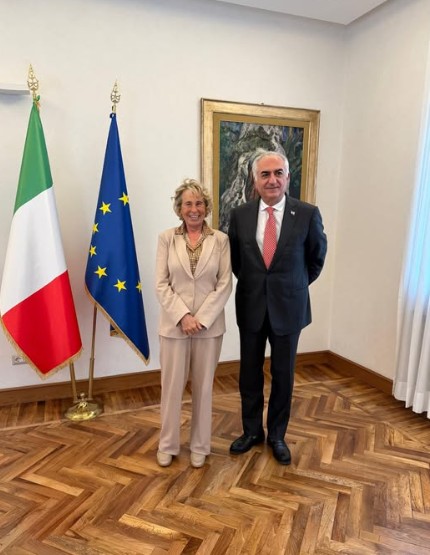
What is Reza Pahlavi doing in Italy? The son of the Shah ousted by the Islamic revolution in 1979 is in the Mediterranean country in the middle of a tour which has already seen him in Stockholm.
The man, now living in the US though apparently without American citizenship, is set to have several meetings with Italian politicians and – apparently – business people. Among the first, member of the Senate Stefania Craxi (Forza Italia, center right), which received him in the morning of April 15th. Others are following.
Pahlavi is wandering Europe to gain consensus for a candidature to legitimately succeed to the ayatollahs in case of a regime change in Iran.
Among his close entourage, the entrepreneur Mariofilippo Brambilla, president of the “Associazione Italia-Iran”. Brambilla is helping Pahlavi with improving his media presence in Italy: he gave interviews over the course of the years on the topic and, regardless of the working relation, even personally wrote an interview to Pahlavi on the national newsmagazine Il Giornale, without declaring it and so contravening basic editorial standards. On Thursday, Pahlavi will join a closed door round table moderated by Daniele Capezzone, editor in chief of Il Tempo daily.
Pahlavi is trying to build a mediatic presence in Europe, spreading fake news that people in Iran wants him back. Reality is more complicated than this. Who wants him in the country is a small minority, well photographed during street protests to build consensus in a typical pr operation. An inquiry by the Israeli news outlet Haaretz in collaboration with the Citizen Lab of the University of Toronto (specialized in cybersecurity) reported that Israeli-linked digital influence campaign was promoting Reza Pahlavi among Persian-speaking audiences. Citizen Lab found that an online network pushed out deepfake videos during Israel’s airstrikes on Tehran’s Evin Prison.
That of the Shah was a police-state, and the revolution that lead to the Islamic regime was originally the attempt to gain more freedom. More, not necessarily the kind of freedom a western citizen would imagine. It’s not even clear whether the majority of the Iranian is against the Islamic regime: meaning there’s a difference between the developed urban social classes living in the capital (and abroad) and the people living in the rural areas. Not to mention the part of population co-opted by the regime in more than 45 years in power.
Note: an earlier version of this post said Reza Pahlavi holds American citizenship. I amended it

 Journalism, media and points of view