
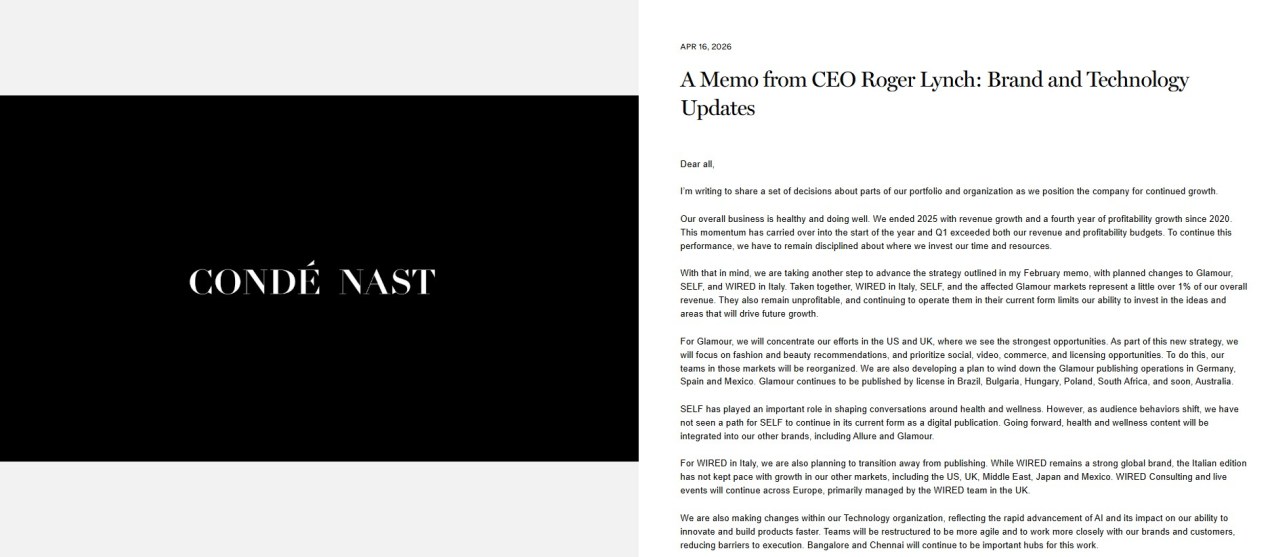
As some of you might know, in the last days Condé Nast communicated the intention to “transition away from publishing” Wired Italia. Whether this is true or just a negotiation tactic, it triggered a lot of considerations about the state of today’s journalism in our relatively small bubble of avid news readers. Being personally involved, moreover, as a long-time contributor pushed me towards doing the effort of getting in depth both in public and private chats.
In a previous post, I considered the possibility of Condé Nast turning the now-magazine in an event-first editorial product.
Someone, like Matteo Cerri (an Italian publisher, not involved in the matter) fundamentally agrees with this vision, based on a classic corporate economic concept. It was unavoidable (I summarize) given the editorial market and the fact that the Ai allows to make a newsmagazine with a tiny fraction of the personnel. That, moreover, can be rerouted on other projects (like live interviews) in which the human role is still fundamental. A sort of Ted X under Wired’s brand. In the end, who the hell would accept being interviewed by an avatar?
This would probably still be journalism (being a good interviewer is not easy; and the price for impreparation is irrelevance), but of another kind. And, maybe, less valuable for the society itself. We’d loose our “boots on the ground” approach, in favor of a “drone approach” (Sun Tzu’s Art of war is still base to a number of marketing courses: so, I’m not inventing anything with this comparison).
***
Consequentially, and that’s another topic I often discussed in private chats and public conversations, we fatally get to a question: can we really treat the press just like any other industry? Sure, it has more or less always been like this for publishers; but the role of democracies’ watchdog is too important to be underrated or equalized to beauty farms or pet food.
Acting as a devil’ lawyer, I used to answer that nobody has found the recipe to conjugate business and social impact, yet. But, in reality, there’s already someone who’s trying to make business differently: the so-called B-Corps.
Which (with some limits I’m not going to discuss here) have a community-oriented approach.
But what is a B-Corp? Briefly put, these companies consciounsly renounce to a part of their profits – or, to say it in another way, to the maximum optimization and efficiency – to pursue an impact on the people and the planet.
So, if a publisher like Condé Nast considers closing Wired Italia for economic reasons, and we had to find a reason to ask them to think again about it, we could say that it already has a number of other incredibly performing outlets in its bouquet.
Like, for example, Vogue Italia; and – with all due respect to fashion and pop culture – we’re not talking of the same impact in terms of democracy.
I explain: Wired Italia started talking about digital surveillance, algorithms’ ethic, Big Tech’s malpractices, and even climate tech and renewables when these topics just deserved a small article at the bottom of traditional media: it shaped the debate, paving the way to others. And there’s no need to further underline the importance of these topics in today’s world. Vogue Italia can well sustain the burden of a less profitable (but, as far as I know, not unprofitable) news outlet like Wired Italia.
Even companies operating on average economic sectors are considering the switch towards a B-Corp minded way of doing business. Why in the world can’t a liberal publisher like Condé do the same?
***
Here comes another consideration.
In this “transitioning away from publishing process” involving artificial intelligence, what’s happening to the content already published? Will it be sold with some sort of agreeements to actors like Open AI? Stop guessing. It already happened.
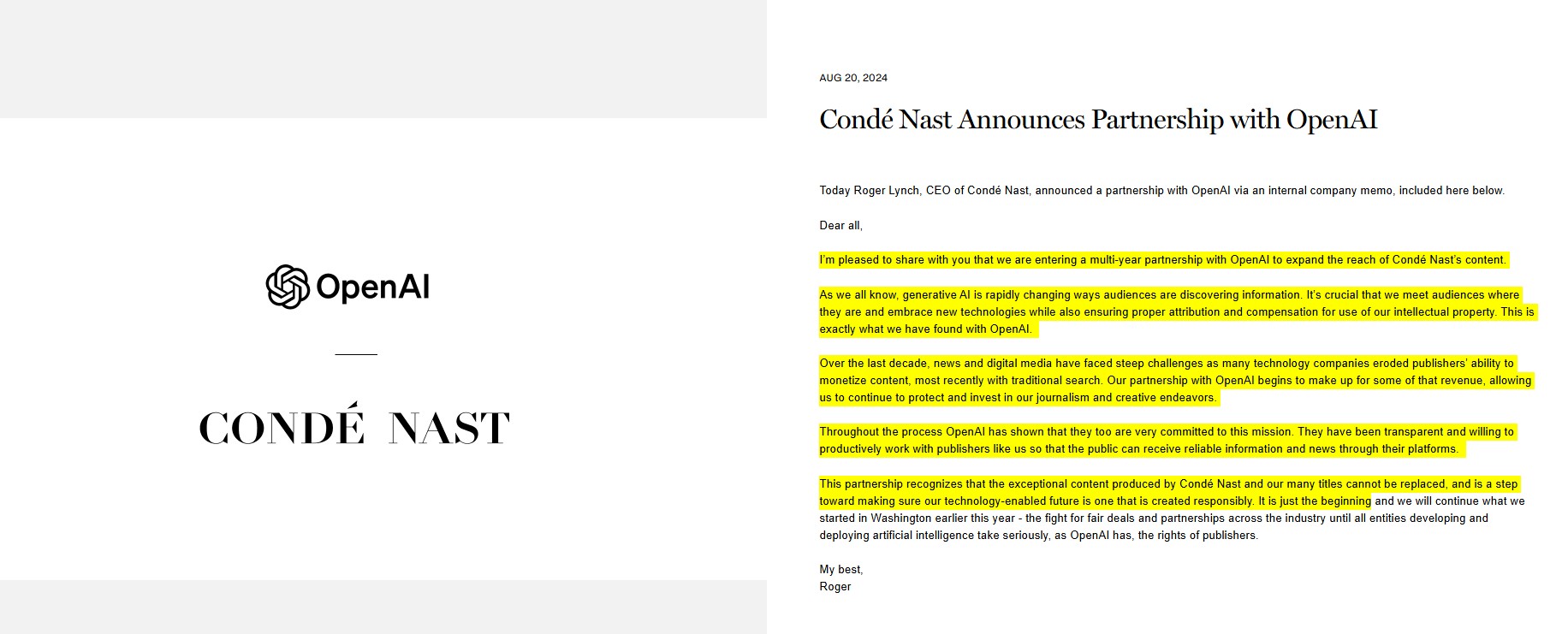
You can find here Open AI’s version, and here Condé Nast’s. I quote from the latter.
“I’m pleased to share with you that we are entering a multi-year partnership with OpenAI to expand the reach of Condé Nast’s content”, wrote ceo Roger Lynch in August 2024.
“As we all know, generative AI is rapidly changing ways audiences are discovering information. It’s crucial that we meet audiences where they are and embrace new technologies while also ensuring proper attribution and compensation for use of our intellectual property. This is exactly what we have found with OpenAI.
Over the last decade, news and digital media have faced steep challenges as many technology companies eroded publishers’ ability to monetize content, most recently with traditional search. Our partnership with OpenAI begins to make up for some of that revenue, allowing us to continue to protect and invest in our journalism and creative endeavors.
Throughout the process OpenAI has shown that they too are very committed to this mission. They have been transparent and willing to productively work with publishers like us so that the public can receive reliable information and news through their platforms.
This partnership recognizes that the exceptional content produced by Condé Nast and our many titles cannot be replaced, and is a step toward making sure our technology-enabled future is one that is created responsibly. It is just the beginning [….]”
So the incredibly valuable content written by Wired journalists’ over the course of the years might be already used to train those very AI systems cannibalizing them.
Condé is not alone. Stated Open AI: it joined “a growing list of publishers including Associated Press, Axel Springer, The Atlantic, Dotdash Meredith, Financial Times, LeMonde, NewsCorp, Prisa Media, TIME, Vox Media and others, in our mission to integrate journalism more deeply with AI services”. “We’re committed to working with Condé Nast and other news publishers to ensure that as AI plays a larger role in news discovery and delivery, it maintains accuracy, integrity, and respect for quality reporting“, added Brad Lightcap (COO at OpenAI).
Quite every editorial group had to come to terms with AI. And it’s not clear if anyone’s found yet a way to maintain the journalists employed giving them an additional tool or it’s simply impossible.
Yes, it’s just the beginning.
Ps You can sign this petition to save Wired Italia, if you want.


Pingback: Why Ai is not good for most of the journalists | Journalism, media and points of view