
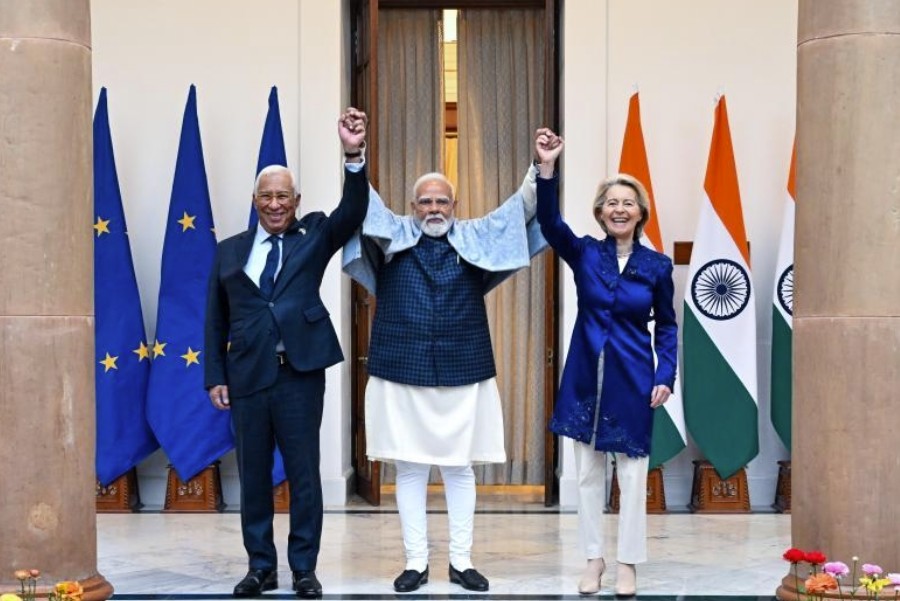
The EU and India concluded negotiations today on one of the most ambitious free trade agreements ever for both. All along the economic aspects, renewed collaboration is expected on key topics, like security (even cybersec) and defence, classified information, climate, disaster management, startups.
It doensn’t look the timing is casual, obviously.
Donald Trump openly menaced the EU with tariffs from the United States in the last months while the agreement will cut them for a variety of goods exchanged between the Old continent and India. And when it comes to defence, there’s not much to add to the bullying over Greenland, counterbalanced by the search of new alliances.
Some figures. The EU and India already trade over €180 billion worth of goods and services per year, supporting close to 800,000 EU jobs, as referred by Bruxelles. The deal is expected to double EU goods exports to India by 2032 by eliminating or reducing tariffs in value of 96.6% of EU goods exports to India. Overall, the tariff reductions will save around €4 billion per year in duties on European products.
Bruxelles is reacting in a polite way, as usual. But it’s reacting, it’s doing it fastly, and that’s important. Please note that negotiations started in 2007, and were suspended in 2013 (in the same period, a diplomatic crisis involved 2 Italian troops accused of killing a fisherman). At the time, India was looking for a role on the international arena, to accreditate itself as a mid sized power, and wat way too assertive, so to speak.
Things have changed, in the meantime, and talks have been relaunched in 2022, accelerating last October. The country now is the most populous in the world, and the 4th largest economy. Not only. It hasn’t to struggle with demographic issues as China, burdened by an older population and the outcomes of the one-child policy of the 20th century. Moreover, the upper classes speaks English and uses Latin alphabet; it’s a democracy and its legal system is understandable and modelled on the British, and there’s still a deep tie with London.
In brief, India might be one of the countries to monitor in the next years.
It also has problems: a variety of languages, poverty, internal conflicts between Induists (largely dominant) and Muslims. Narendra Modi, the prime minister, can be tough in his repression. But Delhi’s constitution and institutions have proved resilient over time.
A few would have predicted this only 10 years ago.
Now the agreement needs to be finalized. On the EU side, the negotiated draft texts will be published shortly. The texts will go through legal revision and translation into all official EU languages. The Commission will then put forward its proposal to the Council for the signature and conclusion of the agreement. Once adopted by the Council, the EU and India can sign the agreements. Following the signature, the agreement requires the European Parliament’s consent, and the Council’s decision on conclusion for it to enter into force. Once India also ratifies the Agreement, it can enter into force.
It’s going to take time. But that of today is a good base (more info here). In the press release Trump is never mentioned, but is clearly present when Ursula von der Leyen comments “We have sent a signal to the world that rules-based cooperation still delivers great outcomes”. How will he react?
This deal might be considered a sign of hope in a future in which bullying lets diplomacy go ahead. Peace has been always built on trades – and even though globalization had plenty of excesses and lead us to deep inequalities, the world needs to correct its flaws while maintaing its most positive impact – a stable world.
 Journalism, media and points of view